The Machines: Daddy's Guide to At-Home Skincare Devices
LED masks, microcurrent, radio frequency and the ultrasonic spatula. What each machine actually does, what it doesn't, and the order Daddy runs them in.
The clinic charges by the session. The machine charges once. Daddy has done the math, and the math comes with a charging cable.
There was a time when a facial with a machine in it meant an appointment, a robe, a whispered menu and a bill that arrived like a verdict. Radio frequency, microcurrent, LED: all of it lived behind a reception desk. It doesn't anymore. The technology has shrunk to something that fits in a drawer, and the drawer is where Daddy keeps it.
This is not a piece about miracles. A device will not undo a decade or replace a surgeon, and anyone who tells you otherwise is selling you something louder than skincare. What the good ones do is quieter: they make the skin you have work harder, a few minutes at a time, for as long as you keep showing up. Consistency is the active ingredient. The machine is just the delivery.
Daddy has picked one house for the drawer, Blyss, because its four devices cover the four technologies worth owning, and they fit together in an order that makes sense. Here is what each technology does, then the machines, then the routine.
What the machines actually do
Four technologies, four jobs. Learn the difference and you will never again buy a gadget because the box was shiny.
LED light therapy
Light at specific wavelengths, delivered to bare skin for ten to twenty minutes. Red (around 630 nanometres) and near-infrared are the ones used for firmness, texture and recovery, and red light has more published research behind it than anything else in this piece. The results are real but gradual: think months, not mornings. Blue is the one used on breakouts. It doesn't hurt, it doesn't heat, and it is the easiest of the four to keep doing, which is why it matters most.
Microcurrent and EMS
A low electrical current, passed through the face while a device glides across it. Microcurrent and EMS (electrical muscle stimulation) are cousins: both work on the small muscles under the skin, and the effect is a lifted, sharper look along the jaw and brow. It is the most immediate of the four, visible the same day, and the least permanent, which is the deal. Stop, and it fades. Keep at it, and it holds.
Radio frequency
Gentle heat, delivered below the surface. RF warms the deeper layers of the skin, and that warmth is the signal skin reads as a reason to rebuild collagen. It is the slow one: tightening along the jaw and the neck, built over weeks of regular use. Home devices run far cooler than the clinic versions, which is the point. You can use them three times a week without anyone handing you a waiver.
The ultrasonic spatula
A steel blade that vibrates faster than you can feel, 24,000 times a second on the one Daddy keeps. Glided over damp skin, it lifts oil and dead skin out of the pores without scrubbing. It is the cleanest way Daddy knows to start a session, because every machine that follows works better on skin with nothing sitting on top of it.
The four in Daddy's drawer
Blyss Iris: the ultrasonic scrubber
The first step and the least glamorous, which is how you know it matters. Blyss Iris$180.00 is a stainless steel spatula with three modes: an ultrasonic cleanse that pushes out what is sitting in the pores, an ion mode that helps the serum after it go further, and a microcurrent lift to finish. Two or three times a week, on damp skin, the blade held at a shallow angle. Then the serum goes on while the skin is still listening.
Blyss Luna: the face
If Daddy kept one machine, it would be this one. Blyss Luna$350.00 puts radio frequency, EMS and red and yellow LED into a single handset with rolling heads, so the lift, the tightening and the light happen in one five-to-ten-minute pass. Work it upward: jaw to cheekbone, cheekbone to temple, between the brows and up into the hairline. It needs something wet to glide on, and that is a step of its own, below.
Blyss Aria: the neck
The neck is where a man's age is told honestly. Faces get attention; necks get forgotten, and then one day there is a photograph. Blyss Aria$290.00 is built for the jaw and neck, with a curved four-point head that follows the line under the chin. It runs radio frequency with EMS and red light, plus a vibration massage for the puffiness that settles under the jaw after a salty dinner. Long upward strokes, collarbone to jaw. Five to ten minutes. Never press down.
Blyss Helio: the mask
Then you lie down. Blyss Helio$450.00 is a soft silicone LED mask (red, deep red, near-infrared and blue) worn for ten to twenty minutes while you do nothing at all. It is cordless, it comes with goggles, and it is the most sociable of the four. Daddy has answered email in it. The person on the other end did not need to know.
Three smaller ones
Not every machine needs a Sunday. These three are smaller, cost less, and are the easier way to start.
 Blyss Lila is a pen-sized eye device: radio frequency, EMS and light around the orbital bone, over an eye serum. Two or three minutes an eye, never on the lid.$180.00
 Blyss Mira is LED for the man who won't wear a mask: red, yellow and blue light in the palm of the hand, with warmth and vibration, in five minutes.$136.00
 Blyss Maia is a sonic silicone brush for a better wash than hands can manage, with a heated end for a short massage around the eyes.$180.00
Or buy the drawer
Two of the machines also come as sets, and either is the sensible way in.
 The Blyss Ritual Set is the whole routine in one box: Iris to clean, Luna to lift, the Helio mask to finish. Three machines in their proper order, for less than buying them one at a time.$901.00
 The Blyss Essentials Duo pairs Luna with Maia, a sonic cleansing brush, for the man who wants the lift and a better wash and is not yet ready to lie down in a mask.$470.00
The order of operations
The machines are only as good as what goes under them. Here is the full session, the way Daddy runs it on a Sunday night. Weeknights borrow two steps from the middle; the schedule is further down.
1. Cleanse, properly
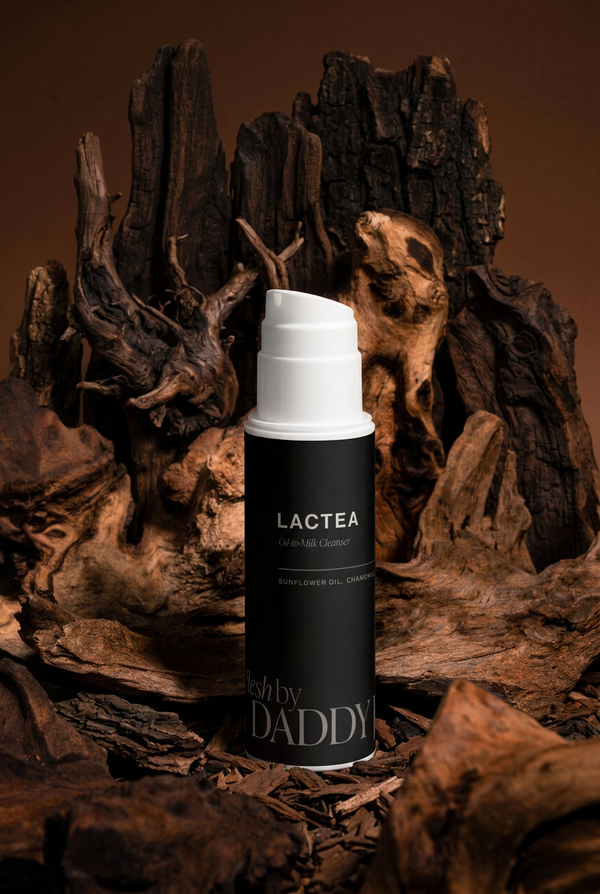
Everything starts on clean skin, because a machine will drive whatever is on your face a little deeper. LACTEA$29.00 goes on dry as an oil, turns to milk with water, and takes the day off without stripping anything else. Rinse, and leave the face damp.
2. Iris, two or three nights a week
The spatula in cleansing mode, over the nose, chin and forehead, where the pores are loudest. Two minutes. Wipe the blade.
3. The glide layer
Luna and Aria need something to move across, and it should be water-based: a conductive layer carries the current, and an oil gets in its way. A face oil here is the most common mistake there is. The device drags, and does less. Daddy uses SURGE$35.00, a double hyaluronic gel, and uses a lot of it, a layer thick enough that the head never touches dry skin. Reapply the moment it starts to tack.
4. Luna on the face, Aria on the neck
Five to ten minutes each, always upward, always moving. Don't park a radio frequency device in one spot; keep the head travelling and the skin stays comfortably warm rather than hot. On nights you're short of time, pick one. The neck, if you've been ignoring it.
On the nights the neck gets the full treatment, Daddy follows Aria with Natura Bissé Inhibit Tensolift Neck Serum$462.75, made for exactly that stretch of skin, pressed in while it is still warm. It is not a cheap habit. It is a good one.
5. The mask, on bare skin
Wipe away what is left of the gel before the Helio mask goes on. LED works best on clean, bare skin with nothing between it and the light. Goggles on. Ten minutes on the anti-ageing setting, twenty if it has been a week.
6. Then feed it
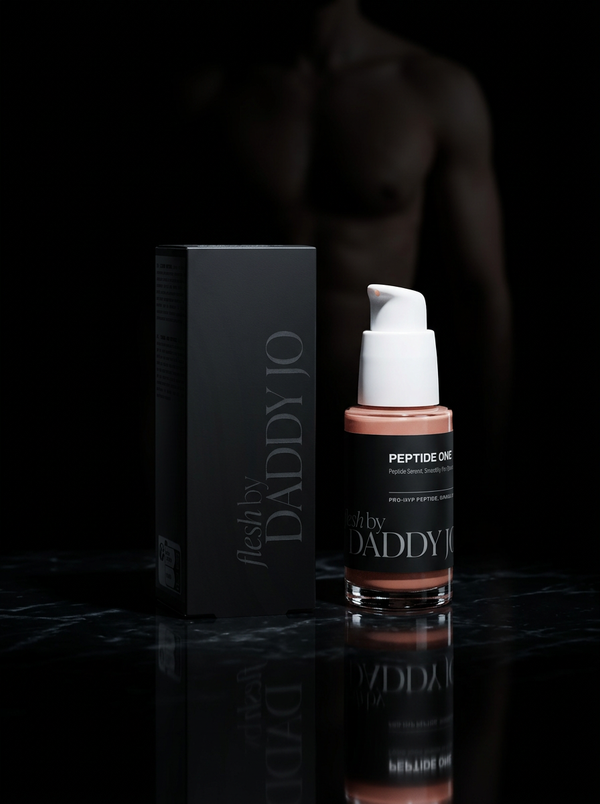
The skin is warm, clean and at its most receptive, and this is the moment for the serum that does the real work. PEPTIDE ONE$55.00 is the one Daddy reaches for after the machines. Peptides are the messengers that tell skin to firm up, and you have just spent half an hour asking it to. If you ran Iris tonight, switch it to ion mode and press the serum in.
For the nights that call for it, La Prairie White Caviar Pearl Infusion$742.75 goes on instead, a firming, illuminating serum and the most expensive thing in this piece by some distance. Daddy does not use it every night. Daddy uses it on the nights he wants to look like he uses it every night.
7. Seal
SOMNUS$45.00, the ceramide night cream, closes the session. Ceramides rebuild the barrier, and after this much attention the barrier deserves the courtesy. Then bed. The work happens while you sleep.
Consistency is the active ingredient. The machine is just the delivery.
The weekly schedule
Nobody does a forty-minute session every night, and nobody needs to. Daddy's week:
- Sunday: the full session, start to finish.
- Tuesday and Thursday: Luna on the face, then the Helio mask. Twenty minutes, most of it lying down.
- Wednesday: Iris, then serum. Five minutes.
- Every other night: cleanse, serum, night cream. The machines rest. So should you.
What not to do
- Don't run the machines on the same night as an acid or a retinoid. Freshly exfoliated skin and heat are a bad combination. Give the acids their own nights.
- Don't use radio frequency or microcurrent if you have a pacemaker or another implanted device, if you're pregnant, or over metal implants in the face. Ask your doctor first. This is the one place Daddy defers.
- Don't take the spatula to active breakouts, broken skin or a fresh shave. Give a shaved face a few hours.
- Don't look into the LED without the goggles. They are in the box for a reason.
- Don't expect a facelift. Expect a better version of your own face, which is rarer.
The questions Daddy gets asked
Do at-home skincare devices actually work?
Yes, within limits. They are less powerful than a clinic machine, by design, so results build more slowly and depend entirely on whether you keep using them. Microcurrent shows the same day and fades; radio frequency and LED build over weeks. Daddy would take a device used three times a week over a clinic session booked twice a year.
Microcurrent or radio frequency: which one first?
If you're buying one, buy the one that does both. Blyss Luna runs RF and EMS in the same pass, which is why it is the machine Daddy would keep. If the neck is the concern, Aria.
Is an LED mask worth it for men?
Skin doesn't know who owns it. A beard changes nothing for the light on the cheekbones, forehead and neck, and the mask is the easiest habit in this piece to keep. You lie down, you wait. That is the whole skill.
How long before I see results?
Roughly: microcurrent, the same evening. Texture and tone from LED, a month of regular use. Firmness from radio frequency, eight to twelve weeks. Take a photograph on day one, in the same light, and don't look at it again until the third month.
The rest of the face lives on the Face page. And if the machines have put you in the mood for something more expensive, Daddy Loves Lux is where the rest of the drawer is kept.
Who's your Daddy? Daddy Jo.